HEADQUARTERS
Insignary Inc. 181 Bay Street, Suite 4400 Toronto, Ontario, Canada M5J 2T3
Email: info@insignary.com





Open source components speed up development and reduce cost — but they can also introduce vulnerabilities that attackers can easily exploit.
With thousands of new vulnerabilities disclosed each year, software that’s secure today could be compromised tomorrow.
AI coding assistants are trained on open source and other public code bases, and rely on open source heavily.
In addition to the open source components your team uses, your vendors and partners may also provide binaries that are incorporated into your products.
These binaries also include open source components and can lead to additional security risk.

Insignary Clarity reduces security risk in your software by analyzing source code and compiled applications and components to generate a Software Bill of Materials (SBOM), then mapping those components to a database of known vulnerabilities.

The security profile of an application changes when a new vulnerability is disclosed.

Clarity helps development and security teams maintain the security of their applications by continuously monitoring the vulnerability landscape.

Clarity alerts teams to new vulnerabilities in each of their affected applications – without the need to rescan.

AI coding assistants used in “vibe coding” are trained on public projects and open source software, pulling freely from both to deliver required functionality.

With thousands of new vulnerabilities reported in open source each year, AI coding assistants trained on older versions of components can easily introduce exploitable vulnerabilities. As new vulnerabilities are disclosed, software that was previously secure may now be vulnerable.

Insignary Clarity identifies open source components in both source code and binary forms, alerting teams to those with known vulnerabilities.
Simply upgrading a component to address one vulnerability may introduce other vulnerabilities.
Clarity provides detailed information on all vulnerabilities in all versions of each component to help developers make informed decisions about how to address issues.
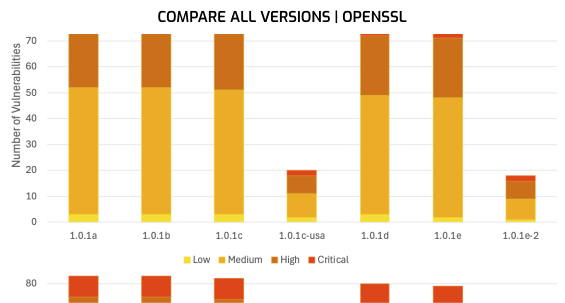
Clarity provides CVSS and EPSS (Exploit Prediction Scoring System) scores to determine vulnerability criticality and exploitability.
It further highlights vulnerabilities with publicly available exploits.

Clarity provides more accurate results than other binary SCA solutions and minimizes unnecessary rework by providing information on whether the vulnerable portion of the component is used.

Clarity provides alerts when personal information, hard coded IP addresses or URLs, and unencrypted passwords are detected in a file.


